Johann Wolfgang von Goethe Quotes
The article provides quotes from Johann Wolfgang von Goethe who is one the greatest figures in German literature. The Goethe quotes deal with many and various topics such as character, truth and wisdom, values and virtues, science and literature.
“It is a great error to take oneself for more than one is, or for less than one is worth.” – Johann Wolfgang von Goethe
“Character in matters great and small consists in a man steadily pursuing the things of which he feels himself capable.” – Johann Wolfgang von Goethe
“If I am to listen to another man’s opinion, it must be expressed positively. Of things problematical I have enough in myself.” – Johann Wolfgang von Goethe
“Tell me with whom you associate, and I will tell you who you are.” – Johann Wolfgang von Goethe
“Love of truth shows itself in this, that a man knows how to find and value the good in everything.” – Johann Wolfgang von Goethe
“Wisdom lies only in truth.” – Johann Wolfgang von Goethe
“Literature decays only as men become more and more corrupt.” – Johann Wolfgang von Goethe
“There is no surer way of evading the world than by art; and no surer way of uniting with it than by art.” – Johann Wolfgang von Goethe
“The greatest piece of good fortune is that which corrects our deficiencies and redeems our mistakes.” – Johann Wolfgang von Goethe
“There are two powers that make for peace: what is right, and what is fitting.” – Johann Wolfgang von Goethe
Associates as Reflections of One’s Personality Quote from Johann Wolfgang von Goethe
“When I err, every one can see it; but not when I lie.” – Johann Wolfgang von Goethe
“It is not always needful for truth to take a definite shape; it is enough if it hovers about us like a spirit and produces harmony; if it is wafted through the air like the sound of a bell, grave and kindly.” – Johann Wolfgang von Goethe
“The most insignificant man can be complete if he works within the limits of his capacities, innate or acquired; but even fine talents can be obscured, neutralised, and destroyed by lack of this indispensable requirement of symmetry.” – Johann Wolfgang von Goethe
“Work makes companionship.” – Johann Wolfgang von Goethe
“Every one suffers who does not work for himself. A man works for others to have them share in his joy.” – Johann Wolfgang von Goethe
“Enthusiasm is of the greatest value, so long as we are not carried away by it.” – Johann Wolfgang von Goethe
“Generosity wins favour for every one, especially when it is accompanied by modesty.” – Johann Wolfgang von Goethe
“It is only men of practical ability, knowing their powers and using them with moderation and prudence, who will be successful in worldly affairs.” – Johann Wolfgang von Goethe
“Vanity is a desire of personal glory, the wish to be appreciated, honoured, and run after, not because of one’s personal qualities, merits, and achievements, but because of one’s individual existence. At best, therefore, it is a frivolous beauty whom it befits.” – Johann Wolfgang von Goethe
“People who contradict and dispute should now and then remember that not every mode of speech is intelligible to every one.” – Johann Wolfgang von Goethe
Work Quote from Johann Wolfgang von Goethe
“We really learn only from those books which we cannot criticise. The author of a book which we could criticise would have to learn from us.” – Johann Wolfgang von Goethe
“The most original authors of modern times are so, not because they produce what is new, but only because they are able to say things the like of which seem never to have been said before.” – Johann Wolfgang von Goethe
“A man who has no acquaintance with foreign languages knows nothing of his own.” – Johann Wolfgang von Goethe
“Piety is not an end, but a means: a means of attaining the highest culture by the purest tranquility of soul.” – Johann Wolfgang von Goethe
“When a man is old, he must do more than when he was young.” – Johann Wolfgang von Goethe
“Ingratitude is always a kind of weakness.” – Johann Wolfgang von Goethe
“Clever people are the best encyclopedia.” – Johann Wolfgang von Goethe
“What, then, is your duty? What the day demands.” – Johann Wolfgang von Goethe
“We may learn to know the world as we please: it will always retain a bright and a dark side.” – Johann Wolfgang von Goethe
“The truest liberality is appreciation.” – Johann Wolfgang von Goethe
“We can’t form our children on our own concepts; we must take them and love them as God gives them to us.” – Johann Wolfgang von Goethe
Doing More When Old Quote from Johann Wolfgang von Goethe
“All the knowledge I possess everyone else can acquire, but my heart is all my own.” – Johann Wolfgang von Goethe
“As we grow older, the ordeals grow greater.” – Johann Wolfgang von Goethe
“Difficulties increase the nearer we come to out aim.” – Johann Wolfgang von Goethe
“Where I cannot be moral, my power is gone.” – Johann Wolfgang von Goethe
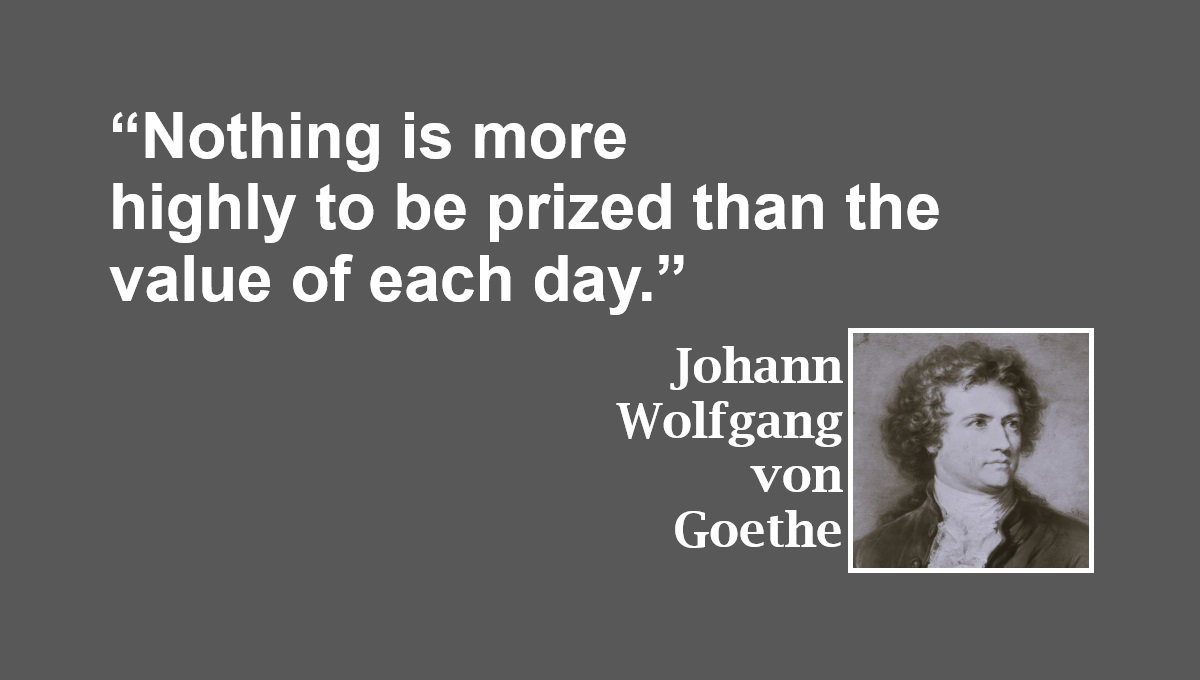
“Nothing is more highly to be prized than the value of each day.” – Johann Wolfgang von Goethe
“Contradiction and flattery make, both of them, bad conversation.” – Johann Wolfgang von Goethe
“An intelligent man finds almost everything ridiculous, a wise man hardly anything.” – Johann Wolfgang von Goethe
“An old foundation is worthy of all respect, but it must not take from us the right to build afresh whenever we will.” – Johann Wolfgang von Goethe
“The real scholar learns how to evolve the unknown from the known, and draws near the master.” – Johann Wolfgang von Goethe
“The first and last thing that is required of genius is love of truth.” – Johann Wolfgang von Goethe
“To err is to be as though truth did not exist. To lay bare the error to oneself and others is retrospective discovery.” – Johann Wolfgang von Goethe
“To a new truth there is nothing more hurtful than an old error.” – Johann Wolfgang von Goethe
“Let us remember how great the ancients were; and especially how the Socratic school holds up to us the source and standard of all life and action, and bids us not indulge in empty speculation, but live and do.” – Johann Wolfgang von Goethe
“There is no such thing as patriotic art and patriotic science. Both art and science belong, like all things great and good, to the whole world, and can be furthered only by a free and general interchange of ideas among contemporaries, with continual reference to the heritage of the past as it is known to us.” – Johann Wolfgang von Goethe
“All the knowledge I possess everyone else can acquire, but my heart is all my own.” – Johann Wolfgang von Goethe
“A man who has no acquaintance with foreign languages knows nothing of his own.” – Johann Wolfgang von Goethe
“What, then, is your duty? What the day demands.” – Johann Wolfgang von Goethe
“Our advice is that every man should remain in the path he has struck out for himself, and refuse to be overawed by authority, hampered by prevalent opinion, or carried away by fashion.” – Johann Wolfgang von Goethe
“To err is to be as though truth did not exist. To lay bare the error to oneself and others is retrospective discovery.” – Johann Wolfgang von Goethe
“We really learn only from those books which we cannot criticise. The author of a book which we could criticise would have to learn from us.” – Johann Wolfgang von Goethe
Value of Each Day Quote from Johann Wolfgang von Goethe
Real Scholar Quote from Johann Wolfgang von Goethe